\displaystyle \textbf{Question 1: }\text{Two angles of a triangle measure }  58^{\circ}\text{ and }87^{\circ}.
\displaystyle \text{Find the measure of the third angle.}
\displaystyle \text{Answer:}
\displaystyle \text{Sum of all the angles of a triangle}=180^{\circ}.
\displaystyle \text{Let the third angle}=x^{\circ}.
\displaystyle \therefore 58^{\circ}+87^{\circ}+x^{\circ}=180^{\circ}
\displaystyle \Rightarrow 145^{\circ}+x^{\circ}=180^{\circ}
\displaystyle \Rightarrow x=35^{\circ}.
\displaystyle \therefore \text{The third angle is }35^{\circ}.
\displaystyle \\

\displaystyle \textbf{Question 2: }\text{Three angles of a triangle are in the ratio }  2:5:8.
\displaystyle \text{Find the angles of the triangle.}
\displaystyle \text{Answer:}
\displaystyle \text{Let the angles be }2x,\ 5x\text{ and }8x.
\displaystyle \text{Sum of all the angles of a triangle}=180^{\circ}.
\displaystyle \therefore 2x+5x+8x=180^{\circ}
\displaystyle \Rightarrow 15x=180^{\circ}
\displaystyle \Rightarrow x=12^{\circ}.
\displaystyle \therefore 2x=24^{\circ},\quad 5x=60^{\circ},  \quad 8x=96^{\circ}.
\displaystyle \therefore \text{The angles are }24^{\circ},\  60^{\circ}\text{ and }96^{\circ}.
\displaystyle \\

\displaystyle \textbf{Question 3: }\text{One angle of a triangle is }76^{\circ}  \text{ and the other two angles are equal.}
\displaystyle \text{Find the measure of each angle of the triangle.}
\displaystyle \text{Answer:}
\displaystyle \text{Let each of the two equal angles be }x^{\circ}.
\displaystyle \text{Sum of all the angles of a triangle}=180^{\circ}.
\displaystyle \therefore 76^{\circ}+x^{\circ}+x^{\circ}=180^{\circ}
\displaystyle \Rightarrow 76^{\circ}+2x^{\circ}=180^{\circ}
\displaystyle \Rightarrow 2x=104^{\circ}
\displaystyle \Rightarrow x=52^{\circ}.
\displaystyle \therefore \text{The angles are }76^{\circ},\  52^{\circ}\text{ and }52^{\circ}.
\displaystyle \\

\displaystyle \textbf{Question 4: }\text{One angle of a triangle is }85^{\circ}  \text{ and the other two angles are in the ratio }8:11.
\displaystyle \text{Find the measures of each of the unknown angles.}
\displaystyle \text{Answer:}
\displaystyle \text{Let the two unknown angles be }8x\text{ and }11x.
\displaystyle \text{Sum of all the angles of a triangle}=180^{\circ}.
\displaystyle \therefore 85^{\circ}+8x+11x=180^{\circ}
\displaystyle \Rightarrow 19x=95^{\circ}
\displaystyle \Rightarrow x=5^{\circ}.
\displaystyle \therefore 8x=40^{\circ}\quad\text{and}\quad  11x=55^{\circ}.
\displaystyle \therefore \text{The two unknown angles are }  40^{\circ}\text{ and }55^{\circ}.
\displaystyle \\

\displaystyle \textbf{Question 5: }\text{Three angles of a triangle measure }  (2x)^{\circ},\ (4x-7)^{\circ}\text{ and }(5x-11)^{\circ}.
\displaystyle \text{Find the value of }x\text{ and the measures of all the angles.}
\displaystyle \text{Answer:}
\displaystyle \text{Sum of all the angles of a triangle}=180^{\circ}.
\displaystyle \therefore 2x+(4x-7)+(5x-11)=180
\displaystyle \Rightarrow 11x-18=180
\displaystyle \Rightarrow 11x=198
\displaystyle \Rightarrow x=18.
\displaystyle \therefore 2x=36^{\circ},\quad 4x-7=65^{\circ},\quad  5x-11=79^{\circ}.
\displaystyle \therefore \text{The angles are }36^{\circ},\  65^{\circ}\text{ and }79^{\circ}.
\displaystyle \\

\displaystyle \textbf{Question 6: }\text{In }\Delta ABC,\  \angle A=x^{\circ},\ \angle B=(2x-15)^{\circ}\text{ and}
\displaystyle \angle C=(3x+21)^{\circ}.\ \text{Find the value of }x  \text{ and the measure of all the angles.}
\displaystyle \text{Answer:}
\displaystyle \text{Sum of all the angles of a triangle}=180^{\circ}.
\displaystyle \therefore x+(2x-15)+(3x+21)=180
\displaystyle \Rightarrow 6x+6=180
\displaystyle \Rightarrow 6x=174
\displaystyle \Rightarrow x=29.
\displaystyle \therefore \angle A=29^{\circ},\quad  \angle B=2(29)-15=43^{\circ}.
\displaystyle \angle C=3(29)+21=108^{\circ}.
\displaystyle \therefore \text{The angles are }29^{\circ},\  43^{\circ}\text{ and }108^{\circ}.
\displaystyle \\

\displaystyle \textbf{Question 7: }\text{In }\Delta ABC,\  \angle A=(2x+15)^{\circ},\ \angle B=x^{\circ}\text{ and}
\displaystyle \angle C=(3x-15)^{\circ}.\ \text{Find the value of }x  \text{ and the measure of all the angles}
\displaystyle \text{of the triangle and show that the triangle is isosceles.}
\displaystyle \text{Answer:}
\displaystyle \text{Sum of all the angles of a triangle}=180^{\circ}.
\displaystyle \therefore (2x+15)+x+(3x-15)=180
\displaystyle \Rightarrow 6x=180
\displaystyle \Rightarrow x=30.
\displaystyle \therefore \angle A=2(30)+15=75^{\circ}.
\displaystyle \angle B=30^{\circ}.
\displaystyle \angle C=3(30)-15=75^{\circ}.
\displaystyle \therefore \angle A=\angle C=75^{\circ}.
\displaystyle \text{Since equal angles have equal opposite sides, }BC=AB.
\displaystyle \therefore \Delta ABC\text{ is an isosceles triangle.}
\displaystyle \\

\displaystyle \textbf{Question 8: }\text{In }\Delta ABC,\  \angle A=3\angle B=6\angle C.
\displaystyle \text{Find the angles of the triangle.}
\displaystyle \text{Answer:}
\displaystyle \text{Let }\angle C=x^{\circ}.
\displaystyle \text{Since }\angle A=3\angle B=6\angle C,
\displaystyle \angle A=6x^{\circ}\quad\text{and}\quad  \angle B=2x^{\circ}.
\displaystyle \text{Sum of all the angles of a triangle}=180^{\circ}.
\displaystyle \therefore 6x+2x+x=180
\displaystyle \Rightarrow 9x=180
\displaystyle \Rightarrow x=20.
\displaystyle \therefore \angle A=120^{\circ},\quad  \angle B=40^{\circ},\quad \angle C=20^{\circ}.
\displaystyle \therefore \text{The angles are }120^{\circ},\  40^{\circ}\text{ and }20^{\circ}.
\displaystyle \\

\displaystyle \textbf{Question 9: }\text{In the adjoining figure, it is given that }  \angle ABC=40^{\circ},\ \angle ACD=70^{\circ},
\displaystyle \angle ACB=x^{\circ}\text{ and }\angle EAC=y^{\circ}.  \text{ Find the values of }x\text{ and }y. p10\displaystyle \text{Answer:}
\displaystyle \angle ACB+\angle ACD=180^{\circ}  \quad\text{(Linear pair)}
\displaystyle \Rightarrow x+70^{\circ}=180^{\circ}
\displaystyle \Rightarrow x=110^{\circ}.
\displaystyle \text{In }\Delta ABC,\quad  \angle ABC+\angle ACB+\angle BAC=180^{\circ}.
\displaystyle \Rightarrow 40^{\circ}+110^{\circ}+\angle BAC  =180^{\circ}
\displaystyle \Rightarrow \angle BAC=30^{\circ}.
\displaystyle \angle BAC+\angle EAC=180^{\circ}  \quad\text{(Linear pair)}
\displaystyle \Rightarrow 30^{\circ}+y=180^{\circ}
\displaystyle \Rightarrow y=150^{\circ}.
\displaystyle \therefore x=110^{\circ}\quad\text{and}\quad  y=150^{\circ}.
\displaystyle \\

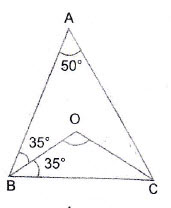
\displaystyle \textbf{Question 10: }\text{In the adjoining figure, it is given that }  \angle A=50^{\circ}\text{ and }\angle B=70^{\circ},
\displaystyle \text{and }BO\text{ and }CO\text{ are bisectors of }\angle B  \text{ and }\angle C\text{ respectively.}
\displaystyle \text{Find the measure of }\angle BOC. P11\displaystyle \text{Answer:}
\displaystyle \text{Since }BO\text{ bisects }\angle B=70^{\circ},
\displaystyle \angle OBC=\frac{70^{\circ}}{2}=35^{\circ}.
\displaystyle \text{In }\Delta ABC,\quad  \angle A+\angle B+\angle C=180^{\circ}.
\displaystyle \Rightarrow 50^{\circ}+70^{\circ}+\angle C=180^{\circ}
\displaystyle \Rightarrow \angle C=60^{\circ}.
\displaystyle \text{Since }CO\text{ bisects }\angle C,
\displaystyle \angle OCB=\frac{60^{\circ}}{2}=30^{\circ}.
\displaystyle \text{In }\Delta BOC,\quad  \angle OBC+\angle OCB+\angle BOC=180^{\circ}.
\displaystyle \Rightarrow 35^{\circ}+30^{\circ}+\angle BOC=180^{\circ}
\displaystyle \Rightarrow \angle BOC=115^{\circ}.
\displaystyle \therefore \angle BOC=115^{\circ}.
\displaystyle \\

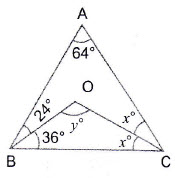
\displaystyle \textbf{Question 11: }\text{Using the information given in the adjoining }  \text{figure, find the values of }x\text{ and }y. P12\displaystyle \text{Answer:}
\displaystyle \text{In }\Delta ABC,\quad  \angle ABC=24^{\circ}+36^{\circ}=60^{\circ}.
\displaystyle \angle ACB=x^{\circ}+x^{\circ}=2x^{\circ}.
\displaystyle \text{Using the angle-sum property of }\Delta ABC,
\displaystyle 64^{\circ}+60^{\circ}+2x^{\circ}=180^{\circ}
\displaystyle \Rightarrow 2x=56^{\circ}
\displaystyle \Rightarrow x=28^{\circ}.
\displaystyle \text{Now, in }\Delta BOC,
\displaystyle \angle OBC+\angle BOC+\angle OCB=180^{\circ}.
\displaystyle \Rightarrow 36^{\circ}+y^{\circ}+28^{\circ}=180^{\circ}
\displaystyle \Rightarrow y=116^{\circ}.
\displaystyle \therefore x=28^{\circ}\quad\text{and}\quad y=116^{\circ}.
\displaystyle \\

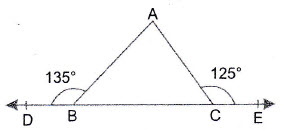
\displaystyle \textbf{Question 12: }\text{In the adjoining figure, }DCBE  \text{ is a straight line,}
\displaystyle \angle ABD=135^{\circ}\text{ and }\angle ACE=125^{\circ}.  \text{ Find }\angle BAC. P13\displaystyle \text{Answer:}
\displaystyle \angle ABD+\angle ABC=180^{\circ}  \quad\text{(Linear pair)}
\displaystyle \Rightarrow \angle ABC=180^{\circ}-135^{\circ}  =45^{\circ}.
\displaystyle \angle ACB+\angle ACE=180^{\circ}  \quad\text{(Linear pair)}
\displaystyle \Rightarrow \angle ACB=180^{\circ}-125^{\circ}  =55^{\circ}.
\displaystyle \text{In }\Delta ABC,\quad  \angle BAC+\angle ABC+\angle ACB=180^{\circ}.
\displaystyle \Rightarrow \angle BAC+45^{\circ}+55^{\circ}  =180^{\circ}
\displaystyle \Rightarrow \angle BAC=80^{\circ}.
\displaystyle \therefore \angle BAC=80^{\circ}.
\displaystyle \\

\displaystyle \textbf{Question 13: }\text{Find, giving reasons, the unknown angles }  \text{marked by }x\text{ and }y\text{ in the following figures.} P14
\displaystyle \text{Answer:}
\displaystyle \text{(i) }\angle ACB=180^{\circ}-123^{\circ}=57^{\circ}  \quad\text{(Linear pair)}
\displaystyle \text{In }\Delta ABC,\quad  x+58^{\circ}+57^{\circ}=180^{\circ}.
\displaystyle \Rightarrow x=65^{\circ}.

\displaystyle \text{(ii) In }\Delta PQR,\quad  x+70^{\circ}+42^{\circ}=180^{\circ}.
\displaystyle \Rightarrow x=68^{\circ}.
\displaystyle 42^{\circ}+y=180^{\circ}  \quad\text{(Linear pair)}
\displaystyle \Rightarrow y=138^{\circ}.

\displaystyle \text{(iii) Since }XY=XZ,\quad  \angle XYZ=\angle YZX=x^{\circ}.
\displaystyle \text{In }\Delta XYZ,\quad  50^{\circ}+x+x=180^{\circ}.
\displaystyle \Rightarrow 2x=130^{\circ}
\displaystyle \Rightarrow x=65^{\circ}.
\displaystyle x+y=180^{\circ}\quad\text{(Linear pair)}
\displaystyle \Rightarrow y=180^{\circ}-65^{\circ}=115^{\circ}.

\displaystyle \text{(iv) Since }AC=AD,\quad  \angle ACD=\angle CDA=70^{\circ}.
\displaystyle \text{In }\Delta ACD,\quad  x+70^{\circ}+70^{\circ}=180^{\circ}.
\displaystyle \Rightarrow x=40^{\circ}.
\displaystyle \angle BCA+\angle ACD=180^{\circ}  \quad\text{(Linear pair)}
\displaystyle \Rightarrow \angle BCA=180^{\circ}-70^{\circ}  =110^{\circ}.
\displaystyle \text{In }\Delta ABC,\quad  y+30^{\circ}+110^{\circ}=180^{\circ}.
\displaystyle \Rightarrow y=40^{\circ}.
\displaystyle \therefore \text{(i) }x=65^{\circ};\quad  \text{(ii) }x=68^{\circ},\ y=138^{\circ};
\displaystyle \text{(iii) }x=65^{\circ},\ y=115^{\circ};\quad  \text{(iv) }x=40^{\circ},\ y=40^{\circ}.
\displaystyle \\

\displaystyle \textbf{Question 14: }\text{In the adjoining figure, if }  \angle A=(x+5)^{\circ},\ \angle B=(2x+3)^{\circ}
\displaystyle \text{and }\angle BCD=(5x-14)^{\circ},\text{ find the value of }x  \text{ and hence, find the measure of}
\displaystyle \text{(i) }\angle BCD\qquad  \text{(ii) }\angle ACB. P15\displaystyle \text{Answer:}
\displaystyle \angle BCD=\angle A+\angle B  \quad\text{(Exterior angle property)}
\displaystyle 5x-14=(x+5)+(2x+3)
\displaystyle \Rightarrow 5x-14=3x+8
\displaystyle \Rightarrow 2x=22
\displaystyle \Rightarrow x=11.
\displaystyle \text{(i) }\angle BCD=5(11)-14=41^{\circ}.

\displaystyle \text{(ii) }\angle ACB+\angle BCD=180^{\circ}  \quad\text{(Linear pair)}
\displaystyle \Rightarrow \angle ACB=180^{\circ}-41^{\circ}=139^{\circ}.
\displaystyle \\

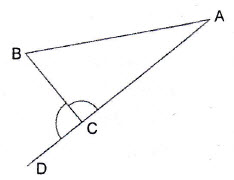
\displaystyle \textbf{Question 15: }\text{In }\Delta ABC,\text{ side }AC  \text{ has been produced to }D.
\displaystyle \text{If }\angle BCD=125^{\circ}\text{ and }  \angle A:\angle B=2:3,\text{ find the measures of}
\displaystyle \angle A\text{ and }\angle B. P16\displaystyle \text{Answer:}
\displaystyle \text{Let }\angle A=2x\text{ and }\angle B=3x.
\displaystyle \angle BCD=\angle A+\angle B  \quad\text{(Exterior angle property)}
\displaystyle \Rightarrow 125^{\circ}=2x+3x
\displaystyle \Rightarrow 5x=125^{\circ}
\displaystyle \Rightarrow x=25^{\circ}.
\displaystyle \therefore \angle A=2(25^{\circ})=50^{\circ}  \quad\text{and}\quad\angle B=3(25^{\circ})=75^{\circ}.
\displaystyle \\

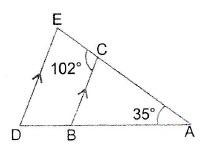
\displaystyle \textbf{Question 16: }\text{In the adjoining figure, it is given that: }  BC\parallel DE,\ \angle BAC=35^{\circ}
\displaystyle \text{and }\angle BCE=102^{\circ}.\text{ Find the measure of }  \text{(i) }\angle ABC\quad\text{(ii) }\angle ADE
\displaystyle \text{and (iii) }\angle CED. P17\displaystyle \text{Answer:}
\displaystyle \text{Since }A,C,E\text{ are collinear,}
\displaystyle \angle BCA+\angle BCE=180^{\circ}  \quad\text{(Angles on a straight line)}
\displaystyle \Rightarrow \angle BCA=180^{\circ}-102^{\circ}  =78^{\circ}.
\displaystyle \text{(i) In }\triangle ABC,\quad  \angle ABC+\angle BCA+\angle BAC=180^{\circ}.
\displaystyle \Rightarrow \angle ABC+78^{\circ}+35^{\circ}  =180^{\circ}.
\displaystyle \Rightarrow \angle ABC=67^{\circ}.

\displaystyle \text{Since }BC\parallel DE,\quad  \angle BCE+\angle CED=180^{\circ}  \quad\text{(Co-interior angles)}
\displaystyle \Rightarrow \angle CED+102^{\circ}=180^{\circ}.
\displaystyle \Rightarrow \angle CED=78^{\circ}.

\displaystyle \text{(ii) In }\triangle ADE,\quad  \angle ADE+\angle DEA+\angle DAE=180^{\circ}.
\displaystyle \text{Here }\angle DEA=\angle CED=78^{\circ}  \text{ and }\angle DAE=\angle BAC=35^{\circ}.
\displaystyle \Rightarrow \angle ADE+78^{\circ}+35^{\circ}  =180^{\circ}.
\displaystyle \Rightarrow \angle ADE=67^{\circ}.

\displaystyle \text{(iii) }\therefore \angle CED=78^{\circ}.
\displaystyle \\

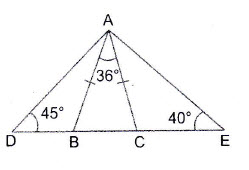
\displaystyle \textbf{Question 17: }\text{In the adjoining figure, it is given that }  AB=AC,\ \angle BAC=36^{\circ},
\displaystyle \angle ADB=45^{\circ}\text{ and }\angle AEC=40^{\circ}.  \text{ Find }\text{(i) }\angle ABC,
\displaystyle \text{(ii) }\angle ACB,\quad\text{(iii) }\angle DAB  \quad\text{and (iv) }\angle EAC. P18\displaystyle \text{Answer:}
\displaystyle AB=AC
\displaystyle \Rightarrow \angle ABC=\angle ACB  \quad\text{(Angles opposite equal sides are equal)}
\displaystyle \text{Let }\angle ABC=\angle ACB=x.
\displaystyle 36^{\circ}+x+x=180^{\circ}  \quad\text{(Angles of }\triangle ABC\text{)}
\displaystyle \Rightarrow 2x=144^{\circ}
\displaystyle \Rightarrow x=72^{\circ}.
\displaystyle \text{(i) }\therefore \angle ABC=72^{\circ}.

\displaystyle \text{(ii) }\therefore \angle ACB=72^{\circ}.

\displaystyle \text{Since }D,B,C,E\text{ are collinear,}
\displaystyle \angle ABD=180^{\circ}-\angle ABC  =180^{\circ}-72^{\circ}=108^{\circ}.
\displaystyle \text{In }\triangle ADB,\quad  \angle DAB+108^{\circ}+45^{\circ}=180^{\circ}.
\displaystyle \text{(iii) }\therefore \angle DAB=27^{\circ}.

\displaystyle \angle ACE=180^{\circ}-\angle ACB  =180^{\circ}-72^{\circ}=108^{\circ}.
\displaystyle \text{In }\triangle ACE,\quad  \angle EAC+108^{\circ}+40^{\circ}=180^{\circ}.
\displaystyle \text{(iv) }\therefore \angle EAC=32^{\circ}.
\displaystyle \\

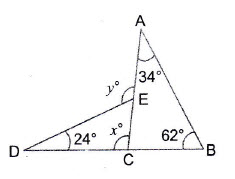
\displaystyle \textbf{Question 18: }\text{Using the information given in the adjoining figure,}  \text{ calculate the values of }x\text{ and }y. P19\displaystyle \text{Answer:}
\displaystyle \text{Since }A,E,C\text{ are collinear, }\angle ACB=180^{\circ}-x.
\displaystyle \text{In }\triangle ABC,\quad  34^{\circ}+(180^{\circ}-x)+62^{\circ}=180^{\circ}.
\displaystyle \Rightarrow 276^{\circ}-x=180^{\circ}.
\displaystyle \Rightarrow x=96^{\circ}.

\displaystyle \text{Since }A,E,C\text{ are collinear, }  \angle DCE=180^{\circ}-\angle ACB=x=96^{\circ}.
\displaystyle \text{Since }D,E\text{ and the point on }AE\text{ form a straight line,}  \angle DEC=180^{\circ}-y.
\displaystyle \text{In }\triangle DCE,\quad  24^{\circ}+96^{\circ}+(180^{\circ}-y)=180^{\circ}.
\displaystyle \Rightarrow 300^{\circ}-y=180^{\circ}.
\displaystyle \Rightarrow y=120^{\circ}.
\displaystyle \therefore x=96^{\circ}\quad\text{and}\quad y=120^{\circ}.
\displaystyle \\

\displaystyle \textbf{Question 19: }\text{Sides }AB\text{ and }AC\text{ of }\Delta ABC  \text{ have been produced to }D\text{ and }E\text{ respectively.}
\displaystyle BI\text{ and }CI\text{ are bisectors of }\angle CBD\text{ and }  \angle BCE\text{ respectively. If }\angle BAC=70^{\circ}
\displaystyle \text{and }\angle ACB=50^{\circ},\text{ find the measure of }  \angle BIC. P20\displaystyle \text{Answer:}
\displaystyle \text{In }\triangle ABC,\quad  \angle ABC+50^{\circ}+70^{\circ}=180^{\circ}.
\displaystyle \Rightarrow \angle ABC=60^{\circ}.
\displaystyle \angle CBD=180^{\circ}-60^{\circ}=120^{\circ}  \quad\text{(Angles on a straight line)}
\displaystyle \text{Since }BI\text{ bisects }\angle CBD,
\displaystyle \angle IBC=\frac{1}{2}\times120^{\circ}=60^{\circ}.

\displaystyle \angle BCE=180^{\circ}-50^{\circ}=130^{\circ}  \quad\text{(Angles on a straight line)}
\displaystyle \text{Since }CI\text{ bisects }\angle BCE,
\displaystyle \angle BCI=\frac{1}{2}\times130^{\circ}=65^{\circ}.

\displaystyle \text{In }\triangle BIC,\quad  \angle IBC+\angle BCI+\angle BIC=180^{\circ}.
\displaystyle 60^{\circ}+65^{\circ}+\angle BIC=180^{\circ}.
\displaystyle \therefore \angle BIC=55^{\circ}.
\displaystyle \\

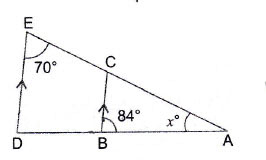
\displaystyle \textbf{Question 20: }\text{In the adjoining figure, it is given that }  BC\parallel DE,\ \angle CED=70^{\circ},
\displaystyle \angle CBA=84^{\circ}\text{ and }\angle BAC=x^{\circ}.  \text{ Find the value of }x. P21\displaystyle \text{Answer:}
\displaystyle \text{Since }BC\parallel DE,\quad  \angle BCA=\angle CED=70^{\circ}\quad\text{(Corresponding angles)}
\displaystyle \text{In }\triangle ABC,\quad  x+84^{\circ}+70^{\circ}=180^{\circ}.
\displaystyle \Rightarrow x=180^{\circ}-154^{\circ}=26^{\circ}.
\displaystyle \therefore x=26^{\circ}.
\displaystyle \\

\displaystyle \textbf{Question 21: }\text{In the adjoining figure, it is given that }  BC\parallel DE,\ \angle EDC=25^{\circ},
\displaystyle \angle ECD=20^{\circ},\ \angle ABC=70^{\circ},  \ \angle BAC=x^{\circ}\text{ and }\angle DEA=y^{\circ}.
\displaystyle \text{Find the values of }x\text{ and }y. P22\displaystyle \text{Answer:}
\displaystyle \text{In }\triangle DEC,\quad  25^{\circ}+20^{\circ}+\angle DEC=180^{\circ}.
\displaystyle \Rightarrow \angle DEC=135^{\circ}.
\displaystyle \text{Since }A,E,C\text{ are collinear,}\quad  y+\angle DEC=180^{\circ}.
\displaystyle \Rightarrow y+135^{\circ}=180^{\circ}.
\displaystyle \Rightarrow y=45^{\circ}.

\displaystyle \text{Since }BC\parallel DE,\quad  \angle ADE=\angle ABC=70^{\circ}\quad\text{(Corresponding angles)}
\displaystyle \text{In }\triangle ADE,\quad  x+70^{\circ}+45^{\circ}=180^{\circ}.
\displaystyle \Rightarrow x=65^{\circ}.
\displaystyle \therefore x=65^{\circ}\quad\text{and}\quad y=45^{\circ}.
\displaystyle \\

\displaystyle \textbf{Question 22: }\text{In the adjoining figure, it is given that }  \angle ACB=42^{\circ},
\displaystyle \angle DEB=\angle CAB=90^{\circ},\quad  \angle ABC=x^{\circ},\quad\angle BDE=y^{\circ}
\displaystyle \text{and }\angle AFE=z^{\circ}.  \text{ Find the values of }x,\ y\text{ and }z. P23\displaystyle \text{Answer:}
\displaystyle \text{In }\triangle ABC,\quad  x+90^{\circ}+42^{\circ}=180^{\circ}.
\displaystyle \Rightarrow x=48^{\circ}.

\displaystyle \text{Since }B,A,D\text{ are collinear, }  \angle DAF=180^{\circ}-90^{\circ}=90^{\circ}.
\displaystyle \text{Also, }\angle DEF=90^{\circ}.
\displaystyle \text{In quadrilateral }ADEF,\quad  90^{\circ}+y+90^{\circ}+z=360^{\circ}.
\displaystyle \Rightarrow y+z=180^{\circ}.\qquad\text{...(i)}

\displaystyle \text{In }\triangle BDE,\quad  x+y+90^{\circ}=180^{\circ}.
\displaystyle 48^{\circ}+y+90^{\circ}=180^{\circ}.
\displaystyle \Rightarrow y=42^{\circ}.

\displaystyle \text{Substituting }y=42^{\circ}\text{ in (i),}
\displaystyle 42^{\circ}+z=180^{\circ}.
\displaystyle \Rightarrow z=138^{\circ}.
\displaystyle \therefore x=48^{\circ},\quad y=42^{\circ}  \quad\text{and}\quad z=138^{\circ}.
\displaystyle \\

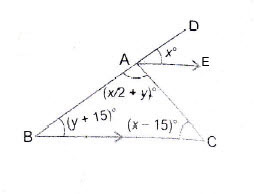
\displaystyle \textbf{Question 23: }\text{In the adjoining figure, }  AE\parallel BC,\ \angle DAE=x^{\circ},
\displaystyle \angle ACB=(x-15)^{\circ},\quad  \angle BAC=\left(\frac{x}{2}+y\right)^{\circ}
\displaystyle \text{and }\angle ABC=(y+15)^{\circ}.  \text{ Find the values of }x\text{ and }y. P24\displaystyle \text{Answer:}
\displaystyle \text{In }\triangle ABC,\quad  (y+15)+(x-15)+\left(\frac{x}{2}+y\right)=180^{\circ}.
\displaystyle \Rightarrow 2y+\frac{3x}{2}=180^{\circ}.  \qquad\text{...(i)}
\displaystyle \text{Since }AE\parallel BC,\quad  \angle DAE=\angle ABC\quad\text{(Corresponding angles)}
\displaystyle \Rightarrow x=y+15.  \qquad\text{...(ii)}
\displaystyle \text{Substituting }x=y+15\text{ in (i),}
\displaystyle 2y+\frac{3}{2}(y+15)=180^{\circ}.
\displaystyle \Rightarrow 4y+3y+45=360^{\circ}.
\displaystyle \Rightarrow 7y=315^{\circ}.
\displaystyle \Rightarrow y=45^{\circ}.
\displaystyle \text{From (ii),}\quad x=45^{\circ}+15^{\circ}=60^{\circ}.
\displaystyle \therefore x=60^{\circ}\quad\text{and}\quad y=45^{\circ}.
\displaystyle \\

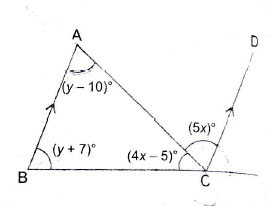
\displaystyle \textbf{Question 24: }\text{In the adjoining figure, }  BA\parallel CD.\text{ Find the values of }x\text{ and }y. P25\displaystyle \text{Answer:}
\displaystyle \text{In }\triangle ABC,\quad  (y+7)+(y-10)+(4x-5)=180^{\circ}.
\displaystyle \Rightarrow 2y+4x=188^{\circ}.  \qquad\text{...(i)}
\displaystyle \text{Since }BA\parallel CD,\quad  \angle BAC=\angle ACD\quad\text{(Alternate interior angles)}
\displaystyle \Rightarrow y-10=5x. \qquad\text{...(ii)}
\displaystyle \Rightarrow y=5x+10.
\displaystyle \text{Substituting }y=5x+10\text{ in (i),}
\displaystyle 2(5x+10)+4x=188^{\circ}.
\displaystyle \Rightarrow 10x+20+4x=188^{\circ}.
\displaystyle \Rightarrow 14x=168^{\circ}.
\displaystyle \Rightarrow x=12^{\circ}.
\displaystyle \text{From (ii),}\quad y-10=5(12)=60.
\displaystyle \Rightarrow y=70^{\circ}.
\displaystyle \therefore x=12^{\circ}\quad\text{and}\quad y=70^{\circ}.
\displaystyle \\


Discover more from ICSE / ISC / CBSE Mathematics Portal for K12 Students

Subscribe to get the latest posts sent to your email.