\displaystyle \textbf{Points to Remember}

\displaystyle \textbf{1. Equal figures: }\text{Two plane figures having equal area are called equal figures.}

\displaystyle \textbf{2. Congruent figures: }\text{Two plane figures having the same shape and size are}
\displaystyle \text{called congruent figures. But two plane figures having equal areas need not}
\displaystyle \text{be congruent.}

\displaystyle \textbf{3. Results on Area of Polygon Regions:}

\displaystyle \text{(i) Parallelograms on the same base and between the same parallels are}
\displaystyle \text{equal in area.}

\displaystyle \text{(ii) The area of a parallelogram is equal to the area of the rectangle on the}
\displaystyle \text{same base and of the same altitude, i.e. between the same parallels.}

\displaystyle \text{(iii) Triangles on the same base and between the same parallels are equal}
\displaystyle \text{in area.}

\displaystyle \textbf{4. Some more results:}

\displaystyle \text{(i) Area of a parallelogram }=\text{Base}\times\text{Height.}

\displaystyle \text{(ii) Area of a triangle }=\frac{1}{2}\times\text{Base}\times\text{Height.}

\displaystyle \text{(iii) Area of a trapezium }=\frac{1}{2}\times\text{(Sum of parallel sides)}  \times\text{Height.}

\displaystyle \text{(iv) Area of a rhombus }=\frac{1}{2}\times\text{Product of diagonals.}

\displaystyle \textbf{5.}

\displaystyle \text{(i) If a triangle and a parallelogram are on the same base and between the}
\displaystyle \text{same parallels, then the area of the triangle is half of the area of the}
\displaystyle \text{parallelogram.}

\displaystyle \text{(ii) Parallelograms on equal bases and between the same parallels are}
\displaystyle \text{equal in area.}

\displaystyle \\

\displaystyle \textbf{Area Axioms}
\displaystyle \textbf{Area Axiom:}\ \text{Every polygonal region has an area and is measured in square units.}
\displaystyle \textbf{Congruent Area Axiom:}\ \text{If }\triangle ABC\text{ and }\triangle DEF\text{ are two congruent triangles, then}
\displaystyle ar(\triangle ABC)=ar(\triangle DEF)
\displaystyle \text{i.e., two congruent regions have equal area.}
\displaystyle \textbf{Rectangle Area Axiom:}\ \text{If }ABCD\text{ is a rectangular region such that}
\displaystyle AB=a\text{ units and }BC=b\text{ units, then}
\displaystyle ar(ABCD)=ab\text{ square units}
\\

\displaystyle \textbf{Parallelograms on the Same Base and Between the Same Parallels}
\displaystyle \textbf{Theorem 1:}\ \text{A diagonal of a parallelogram divides it into two triangles of equal area.}2019-02-09_22-32-31
\displaystyle ar(\triangle ABC)=ar(\triangle ADC)
\displaystyle ar(\triangle ABD)=ar(\triangle BCD)
\\

\displaystyle \textbf{Theorem 2:}\ \text{Parallelograms on the same base and between} \\ \text{the same parallels are equal in area.}2019-02-10_9-54-47
\displaystyle ar(ABCD)=AB\times h
\displaystyle ar(ABFE)=AB\times h
\displaystyle \therefore\ ar(ABCD)=ar(ABFE)
\\

\displaystyle \textbf{Theorem 3:}\ \text{The area of a parallelogram is the product of its} \\ \text{base and the corresponding altitude.}2019-01-12_12-45-40
\displaystyle \text{Let the adjacent sides of the parallelogram be }a\text{ and }b.
\displaystyle \text{Area}=\text{Base}\times\text{Height}
\\

\displaystyle \textbf{Triangle Area Axioms}

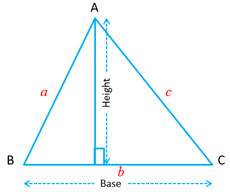
\displaystyle \textbf{Theorem 4:}\ \text{The area of a triangle is half the product of any side} \\ \text{and its corresponding altitude.}2019-01-12_12-49-14
\displaystyle \text{Let }a,\ b,\ c\text{ denote the sides of the triangle.}
\displaystyle \text{Area}=\frac{1}{2}\times\text{Base}\times\text{Height}=\frac{1}{2}bh
\displaystyle \text{Area}=\sqrt{s(s-a)(s-b)(s-c)}
\displaystyle \text{This is known as Heron's Theorem.}
\\

\displaystyle \textbf{Theorem 5:}\ \text{If a triangle and a parallelogram are on the same base} \\ \text{and between the same parallels, then the area of the triangle is half the} \\ \text{area of the parallelogram.}2019-02-10_10-00-24
\displaystyle ar(ABCD)=AB\times h
\displaystyle ar(\triangle ABE)=\frac{1}{2}\times AB\times h
\displaystyle ar(\triangle ABE)=\frac{1}{2}\,ar(ABCD)
\\

\displaystyle \textbf{Trapezium Area Axiom}

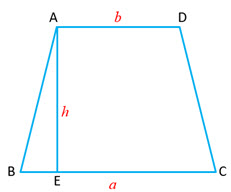
\displaystyle \textbf{Theorem 6:}\ \text{The area of a trapezium is half the product of its height} \\ \text{and the sum of the lengths of its parallel sides.}2019-01-12_12-45-06
\displaystyle \text{A trapezium is a quadrilateral with one pair of parallel sides.}
\displaystyle \text{A trapezium whose non-parallel sides are equal is called an isosceles trapezium.}
\displaystyle \text{Let }a\text{ and }b\text{ be the parallel sides and }h\text{ be the height.}
\displaystyle \text{Area}=\frac{1}{2}(a+b)\times h
\\

\displaystyle \textbf{Triangles on the Same Base and Between the Same Parallels}

\displaystyle \textbf{Theorem 7:}\ \text{Triangles on the same base and between the same} \\ \text{parallels have equal areas.}
\displaystyle ar(\triangle ABD)=\frac{1}{2}\times AB\times h2019-02-10_10-05-29
\displaystyle ar(\triangle ABC)=\frac{1}{2}\times AB\times h
\displaystyle \therefore\ ar(\triangle ABD)=ar(\triangle ABC)
\\
\displaystyle \textbf{Theorem 8:}\ \text{Triangles having equal areas and one side of} \\ \text{one triangle equal to one side of the other have equal corresponding altitudes.}
\\
\displaystyle \textbf{Theorem 9:}\ \text{Two triangles having the same (or equal) bases and} \\ \text{equal areas lie between the same parallels.}


Discover more from ICSE / ISC / CBSE Mathematics Portal for K12 Students

Subscribe to get the latest posts sent to your email.