\displaystyle \textbf{Circle}

\displaystyle \textbf{Introduction}
\displaystyle \text{Consider the shape of the wheel of a bicycle,}
\displaystyle \text{car, etc. Each of these is said to be a circle.}
\displaystyle \text{Observe the path traced by the tip of the minute-hand}
\displaystyle \text{of a wall clock. The path traced is a circle.}

\displaystyle \textbf{Circle}
\displaystyle \text{A circle is defined as the figure (closed curve) obtained}
\displaystyle \text{by joining all those points in a plane which are at the}
\displaystyle \text{same fixed distance from a fixed point in the same plane.}
\displaystyle \text{In fact, a circle is the locus of a point which moves in a}
\displaystyle \text{plane in such a way that its distance from a fixed point, in}
\displaystyle \text{the same plane, always remains constant.}

\displaystyle \text{The perimeter of a circle is called its circumference.}

\displaystyle \text{The fixed point is called the centre of the circle and the fixed distance is called the}
\displaystyle \text{radius of the circle.}

\displaystyle \text{The line segment joining any two points on the circumference of the circle is called a chord.}

\displaystyle \text{A chord which passes through the centre of the circle is called a diameter. }
\displaystyle \text{It is the largest chord of a circle.}

\displaystyle \text{Also, the diameter is twice the radius.}
\displaystyle \text{Diameter}=2\times\text{Radius.}

\displaystyle \textbf{More About Circle}

\displaystyle \textbf{1. Exterior, Interior and Circumference Points}
\displaystyle \text{Draw a circle with radius }r\text{ and centre }O.
\displaystyle \textbf{(i) Exterior point:}
\displaystyle \text{A point lying in the same plane as that of the circle is}
\displaystyle \text{called an exterior point if its distance from the centre}
\displaystyle \text{of the circle is greater than the radius of the circle.}
\displaystyle \text{In the given figure, }A,\ B,\ C\text{ and }
\displaystyle D\text{ are exterior points because} OA,\ OB,\ OC\text{ and }
\displaystyle  OD\text{ are greater than the radius of the circle.}

\displaystyle \textbf{(ii) Interior point:}
\displaystyle \text{A point lying in the same plane as that of the circle is called an interior point}
\displaystyle \text{if its distance from the centre of the circle is less than the radius of the circle.}
\displaystyle \text{In the given figure, }L,\ M\text{ and }N\text{ are interior points because}
\displaystyle OL,\ OM\text{ and }ON\text{ are less than the radius of the circle.}

\displaystyle \textbf{(iii) Point on the circumference of a circle:}
\displaystyle \text{A point in the same plane as that of the circle is said to lie on the circumference}
\displaystyle \text{of the circle if its distance from the centre is equal to the radius of the circle.}
\displaystyle \text{In the given figure, }P,\ Q\text{ and }R\text{ lie on the circumference because}
\displaystyle OP,\ OQ\text{ and }OR\text{ are equal to the radius of the circle.}

\displaystyle \textbf{2. Concentric Circles}
\displaystyle \text{Two or more circles are said to be concentric if}
\displaystyle \text{they have the same centre but different radii.}
\displaystyle \text{In the adjoining figure, }O\text{ is the centre of each}
\displaystyle \text{circle; therefore, the circles are called concentric circles.}

\displaystyle \textbf{3. Equal Circles}
\displaystyle \text{Circles are said to be equal if they have equal radii.}
\displaystyle \text{Equal circles are also called congruent circles.}

\displaystyle \textbf{4. Circumscribed Circle}
\displaystyle \text{A circle that passes through all the vertices of a polygon is called a}
\displaystyle \text{circumscribed circle.}
\displaystyle \text{The centre of a circumscribed circle is called The polygon is called the}
\displaystyle \text{inscribed polygon.}
\displaystyle \text{Some examples of circumscribed circles are shown in the figure.}

\displaystyle \textbf{5. Inscribed Circle}
\displaystyle \text{A circle that touches all the sides of a polygon is called an inscribed circle}
\displaystyle \text{or in-circle of the polygon.}
\displaystyle \text{The centre of an inscribed circle is called the incentre.}
\displaystyle \text{The polygon is called the circumscribed polygon.}
\displaystyle \text{Some examples of inscribed circles are shown in the figure.}

\displaystyle \textbf{Arc, Segment and Sector}

\displaystyle \textbf{1. Arc}
\displaystyle \text{A part of the circumference of a circle is called its arc.}
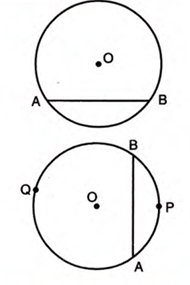
\displaystyle \text{The adjoining figure shows a chord }AB\text{ of a circle} \\ \text{with centre }O.
\displaystyle \text{The chord }AB\text{ divides the circumference of the} \\ \text{circle into two parts,}
\displaystyle \text{and each of these two parts is an arc.}
\displaystyle \text{If both the arcs are unequal in size, the smaller} \\ \text{arc (arc }APB\text{)}
\displaystyle \text{is called the minor arc, whereas the bigger} \\ \text{arc (arc }AQB\text{)}
\displaystyle \text{is called the major arc.}

\displaystyle \textbf{Arc (Important Points)}
\displaystyle \text{If both the arcs are equal, each is called a semi-circle.}
\displaystyle \text{1. A minor arc is always smaller than the semi-circle.}
\displaystyle \text{2. A major arc is always bigger than the semi-circle.}
\displaystyle \text{3. Unless otherwise stated, an arc stands for a minor arc.}

\displaystyle \textbf{2. Segment}
\displaystyle \text{The part of the circle bounded by an arc and a chord is} \\ \text{called a segment.}
\displaystyle \text{In the adjoining figure, chord }AB\text{ divides the circle} \\ \text{into two segments.}
\displaystyle \text{The smaller segment, which is less than a semi-circle,}
\displaystyle \text{is called the minor segment.}
\displaystyle \text{The bigger segment, which is greater than a semi-circle,}
\displaystyle \text{is called the major segment.}
\displaystyle \text{The centre of the circle lies in the major segment.}

\displaystyle \textbf{3. Sector}
\displaystyle \text{The region bounded by an arc and two radii joining the}
\displaystyle \text{centre to the end points of the arc is called a sector.}
\displaystyle \text{In the adjoining figure, the circle has centre }O.
\displaystyle \text{The arc }APB,\text{ radii }OA\text{ and }OB\text{ form the sector }AOBP.
\displaystyle \text{Thus, the shaded region bounded by arc }APB
\displaystyle \text{ and radii }OA\text{ and }OB \ \text{is a sector.}

\displaystyle \textbf{Sector (Important Points)}
\displaystyle \text{1. The minor arc corresponds to the minor sector and the major arc}
\displaystyle \text{corresponds to the major sector.}
\displaystyle \text{2. When both the arcs are equal, the region enclosed by each arc along}
\displaystyle \text{with its diameter is called a semi-circle.}
\displaystyle \text{3. In the case of a semi-circle, both the segments are equal and both the}
\displaystyle \text{sectors are also equal.}

\displaystyle \textbf{Theorem 22}
\displaystyle \textbf{Question: }\text{A straight line drawn from the centre of} \\ \text{a circle to bisect a chord,}
\displaystyle \text{which is not a diameter, is at right angles to the chord.}

\displaystyle \textbf{Given: }\text{A circle with centre }O\text{ and }OC \\ \text{ bisects the chord }AB.
\displaystyle \textbf{To Prove: }OC\perp AB.
\displaystyle \textbf{Construction: }\text{Join }OA\text{ and }OB.

\displaystyle \textbf{Proof:}
\displaystyle \text{In }\triangle OAC\text{ and }\triangle OBC,
\displaystyle OA=OB\qquad\qquad\text{(Radii of the same circle)}
\displaystyle OC=OC\qquad\qquad\text{(Common side)}
\displaystyle AC=BC\qquad\qquad\text{(Given: }OC\text{ bisects }AB\text{)}
\displaystyle \therefore\triangle OAC\cong\triangle OBC\qquad\text{(S.S.S.)}

\displaystyle \angle OCA=\angle OCB\qquad\text{(Corresponding angles of congruent triangles)}
\displaystyle \text{But }\angle OCA+\angle OCB=180^\circ\qquad\text{(A,C,B\text{ are collinear})}
\displaystyle \therefore\angle OCA=\angle OCB=90^\circ
\displaystyle \therefore OC\perp AB.
\displaystyle \textbf{Hence Proved.}

\displaystyle \textbf{Theorem 23 (Converse of Theorem 22)}
\displaystyle \textbf{Question: }\text{The perpendicular to a chord, from the} \\ \text{centre of the circle,}
\displaystyle \text{bisects the chord.}

\displaystyle \textbf{Given: }\text{A circle with centre }O\text{ and }OP\perp AB.
\displaystyle \textbf{To Prove: }AP=BP.
\displaystyle \textbf{Construction: }\text{Join }OA\text{ and }OB.

\displaystyle \textbf{Proof:}
\displaystyle \text{In }\triangle OAP\text{ and }\triangle OBP,
\displaystyle OA=OB\qquad\qquad\text{(Radii of the same circle)}
\displaystyle OP=OP\qquad\qquad\text{(Common side)}
\displaystyle \angle OPA=\angle OPB=90^\circ\qquad\text{(Given: }OP\perp AB\text{)}
\displaystyle \therefore\triangle OAP\cong\triangle OBP\qquad\text{(R.H.S.)}

\displaystyle \therefore AP=BP\qquad\text{(Corresponding parts of congruent triangles are congruent)}
\displaystyle \textbf{Hence Proved.}

\displaystyle \textbf{Remember:}
\displaystyle \text{Greater the size of a chord, smaller is its distance} \\ \text{from the centre, and vice versa.}
\displaystyle \text{If }OP\perp AB\text{ and }OQ\perp CD, \\ \text{ then }AB>CD\Rightarrow OP<OQ.
\displaystyle \text{Conversely, }OP<OQ\Rightarrow AB>CD.

\displaystyle \textbf{Theorem 24}
\displaystyle \textbf{Question: }\text{Equal chords of a circle are} \\ \text{equidistant from the centre.}

\displaystyle \textbf{Given: }\text{A circle with centre }O\text{ in} \\ \text{which chord }AB=CD.
\displaystyle \textbf{To Prove: }\text{If }OP\perp AB\text{ and } \\ OQ\perp CD,\text{ then }OP=OQ.
\displaystyle \textbf{Construction: }\text{Join }OB\text{ and }OD.

\displaystyle \textbf{Proof:}
\displaystyle BP=\frac{1}{2}AB\qquad\text{(Perpendicular from the centre bisects the chord)}
\displaystyle DQ=\frac{1}{2}CD\qquad\text{(Perpendicular from the centre bisects the chord)}
\displaystyle \text{But }AB=CD\qquad\text{(Given)}
\displaystyle \therefore BP=DQ

\displaystyle \text{In }\triangle OPB\text{ and }\triangle OQD,
\displaystyle BP=DQ\qquad\text{(Proved above)}
\displaystyle OB=OD\qquad\text{(Radii of the same circle)}
\displaystyle \angle OPB=\angle OQD=90^\circ\qquad\text{(Since }OP\perp AB\text{ and }OQ\perp CD\text{)}
\displaystyle \therefore\triangle OPB\cong\triangle OQD\qquad\text{(R.H.S.)}

\displaystyle \therefore OP=OQ\qquad\text{(Corresponding parts of congruent triangles are congruent)}
\displaystyle \textbf{Hence Proved.}

\displaystyle \textbf{Theorem 25 (Converse of Theorem 24)}
\displaystyle \textbf{Question: }\text{Chords of a circle, equidistant from the centre, are equal.}

\displaystyle \textbf{Given: }\text{A circle with centre }O\text{ in which }OP\perp AB,\ OQ\perp CD
\displaystyle \text{and }OP=OQ.
\displaystyle \textbf{To Prove: }AB=CD.
\displaystyle \textbf{Construction: }\text{Join }OB\text{ and }OD.

\displaystyle \textbf{Proof:}
\displaystyle \text{In }\triangle OPB\text{ and }\triangle OQD,
\displaystyle OP=OQ\qquad\text{(Given)}
\displaystyle OB=OD\qquad\text{(Radii of the same circle)}
\displaystyle \angle OPB=\angle OQD=90^\circ\qquad\text{(Since }OP\perp AB\text{ and }OQ\perp CD\text{)}
\displaystyle \therefore\triangle OPB\cong\triangle OQD\qquad\text{(R.H.S.)}

\displaystyle \therefore PB=QD\qquad\text{(Corresponding parts of congruent triangles are congruent)}
\displaystyle \text{But }OP\perp AB\text{ and }OQ\perp CD
\displaystyle \therefore PB=\frac{1}{2}AB,\qquad QD=\frac{1}{2}CD
\displaystyle \therefore\frac{1}{2}AB=\frac{1}{2}CD
\displaystyle \therefore AB=CD.
\displaystyle \textbf{Hence Proved.}

\displaystyle \textbf{Theorem 26}
\displaystyle \textbf{Question: }\text{There is one and only one circle which passes through three}
\displaystyle \text{given points not in a straight line.}

\displaystyle \textbf{Given: }\text{Three points }A,\ B\text{ and }C,\text{ which are not in a straight line.}
\displaystyle \textbf{To Prove: }\text{One and only one circle can be drawn through }A,\ B\text{ and }C.
\displaystyle \textbf{Construction: }\text{Join }AB\text{ and }BC.\text{ Draw the perpendicular bisectors of }AB
\displaystyle \text{and }BC.\text{ Let these perpendicular bisectors meet at }O.

\displaystyle \textbf{Proof:}
\displaystyle \text{Since }O\text{ lies on the perpendicular bisector of }AB,
\displaystyle OA=OB\qquad\text{(Each point on the perpendicular} \\ \text{bisector is equidistant from the ends of the} \\ \text{line segment)}

\displaystyle \text{Since }O\text{ lies on the perpendicular bisector of }BC,
\displaystyle OB=OC\qquad\text{(Each point on the perpendicular} \\ \text{bisector is equidistant from the ends of the line segment)}

\displaystyle \therefore OA=OB=OC
\displaystyle \therefore O\text{ is equidistant from }A,\ B\text{ and }C.

\displaystyle \text{Hence, if a circle is drawn with centre }O\text{ and radius }OA,
\displaystyle \text{it will also pass through }B\text{ and }C.

\displaystyle \text{Since the perpendicular bisectors of }AB\text{ and }BC\text{ intersect at only one point }O,
\displaystyle O\text{ is the only point equidistant from }A,\ B\text{ and }C.

\displaystyle \therefore \text{one and only one circle can be drawn through }A,\ B\text{ and }C,
\displaystyle \text{provided they are not collinear.}
\displaystyle \textbf{Hence Proved.}

\displaystyle \textbf{Theorem 27}
\displaystyle \textbf{Question: }\text{If two arcs of the same circle subtend}
\displaystyle \text{equal angles at the centre, they are equal.}

\displaystyle \textbf{Given: }\text{A circle with centre }O.\text{ Arcs }APB \\ \text{ and }CQD\text{ subtend equal}
\displaystyle \text{angles at the centre, i.e., }\angle AOB=\angle COD.
\displaystyle \textbf{To Prove: }\text{arc }APB=\text{arc }CQD.
\displaystyle \textbf{Construction: }\text{Draw chords }AB\text{ and }CD.

\displaystyle \textbf{Proof:}
\displaystyle \text{In }\triangle AOB\text{ and }\triangle COD,
\displaystyle OA=OC\qquad\text{(Radii of the same circle)}
\displaystyle OB=OD\qquad\text{(Radii of the same circle)}
\displaystyle \angle AOB=\angle COD\qquad\text{(Given)}
\displaystyle \therefore\triangle AOB\cong\triangle COD\qquad\text{(S.A.S.)}

\displaystyle \therefore AB=CD\qquad\text{(Corresponding parts of congruent triangles are congruent)}
\displaystyle \therefore\text{arc }APB=\text{arc }CQD\qquad\text{(Equal chords of a circle cut equal arcs)}
\displaystyle \textbf{Hence Proved.}

\displaystyle \textbf{Arc and Chord Properties}

\displaystyle \textbf{1. Equal arcs cut equal chords and equal chords cut equal arcs.}
\displaystyle \text{In a circle, if two arcs are equal, they cut equal chords.}
\displaystyle \text{Conversely, if two chords of a circle are equal, they cut equal arcs.}

\displaystyle \text{Thus, in the figure,}
\displaystyle \text{arc }APB=\text{arc }CQD\Rightarrow\text{chord }AB=\text{chord }CD
\displaystyle \text{and}
\displaystyle \text{chord }AB=\text{chord }CD\Rightarrow\text{arc }APB=\text{arc }CQD

\displaystyle \textbf{2. Equal arcs of two equal (congruent) circles cut equal chords.}
\displaystyle \text{Conversely, if chords of two equal (congruent) circles are equal,}
\displaystyle \text{they cut equal arcs.}

\displaystyle \text{Therefore, in two equal circles,}
\displaystyle \text{if }\text{arc }APB=\text{arc }CQD\Rightarrow\text{chord }AB=\text{chord }CD
\displaystyle \text{and}

\displaystyle \text{if }\text{chord }AB=\text{chord }CD\Rightarrow\text{arc }APB=\text{arc }CQD


\displaystyle \textbf{Theorem 28 (Converse of Theorem 27)}
\displaystyle \textbf{Question: }\text{If two arcs of a circle are equal, they} \\ \text{subtend equal angles at the centre.}

\displaystyle \textbf{Given: }\text{A circle with centre }O. \\ \text{ Equal arcs }APB\text{ and }CQD
\displaystyle \text{subtend }\angle AOB\text{ and } \\ \angle COD\text{ at the centre.}
\displaystyle \textbf{To Prove: }\angle AOB=\angle COD.
\displaystyle \textbf{Construction: } \\ \text{Draw chords }AB\text{ and }CD.

\displaystyle \textbf{Proof:}
\displaystyle \text{Since equal arcs of a circle cut equal chords,}
\displaystyle \text{arc }APB=\text{arc }CQD\Rightarrow AB=CD.

\displaystyle \text{In }\triangle AOB\text{ and }\triangle COD,
\displaystyle OA=OC\qquad\text{(Radii of the same circle)}
\displaystyle OB=OD\qquad\text{(Radii of the same circle)}
\displaystyle AB=CD\qquad\text{(Proved above)}
\displaystyle \therefore\triangle AOB\cong\triangle COD\qquad\text{(S.S.S.)}

\displaystyle \therefore\angle AOB=\angle COD\qquad\text{(Corresponding parts of congruent triangles are congruent)}
\displaystyle \textbf{Hence Proved.}


Discover more from ICSE / ISC / CBSE Mathematics Portal for K12 Students

Subscribe to get the latest posts sent to your email.